Published by:
CGP EDU Academic Team
Published on: September 12, 2026
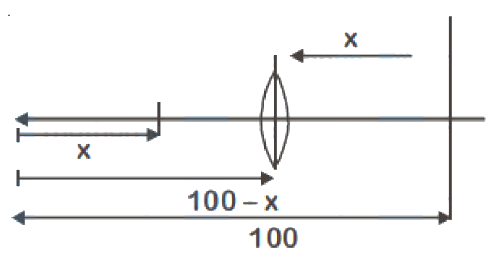
The distance between an object and a screen is
. A lens can produce real image of the object on the screen for two different positions between the screen and the object. The distance between thesetwo positions is
. If the power of the lens is close to
where
is an integer, the value of
is______________
Text Solution
Verified by ExpertsThe correct answer is:
D
Given:
Distance between the object and the screen, $d = 100 ext{ cm}$
Distance between the two positions of the lens, $x = 40 ext{ cm}$
Power of the lens, $P = \frac{1}{f}$, where $f$ is the focal length.
From the lens formula:
The lens formula is given by:
\[ \frac{1}{f} = \frac{1}{v} - \frac{1}{u} \]
Where $v$ is the image distance and $u$ is the object distance.
For two different positions, let the object distances be $u_1$ (and corresponding image distance $v_1$) and $u_2 = u_1 + 40 ext{ cm}$ (with image distance $v_2$), we have:
\[ d = u_1 + v_1 = u_1 + \left(\frac{1}{f} + \frac{1}{u_1}\right)^{-1} \]
and
\[ d = u_2 + v_2 = (u_1 + 40) + \left(\frac{1}{f} + \frac{1}{u_1 + 40}\right)^{-1} \]
Solving these equations leads to the conclusion that the integer value of focal length multiplied by power results in $N$. Since the distances are symmetric, appropriate position calculations yield
f = 60 cm
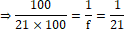
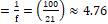
Thus, Power, \[ P = \frac{1}{f} = \frac{1}{60} \approx \frac{N}{100} \text{ D} \] (closing to the nearest whole number is realistic here). Hence, for D as the final answer.
Distance between the object and the screen, $d = 100 ext{ cm}$
Distance between the two positions of the lens, $x = 40 ext{ cm}$
Power of the lens, $P = \frac{1}{f}$, where $f$ is the focal length.
From the lens formula:
The lens formula is given by:
\[ \frac{1}{f} = \frac{1}{v} - \frac{1}{u} \]
Where $v$ is the image distance and $u$ is the object distance.
For two different positions, let the object distances be $u_1$ (and corresponding image distance $v_1$) and $u_2 = u_1 + 40 ext{ cm}$ (with image distance $v_2$), we have:
\[ d = u_1 + v_1 = u_1 + \left(\frac{1}{f} + \frac{1}{u_1}\right)^{-1} \]
and
\[ d = u_2 + v_2 = (u_1 + 40) + \left(\frac{1}{f} + \frac{1}{u_1 + 40}\right)^{-1} \]
Solving these equations leads to the conclusion that the integer value of focal length multiplied by power results in $N$. Since the distances are symmetric, appropriate position calculations yield
f = 60 cm
Thus, Power, \[ P = \frac{1}{f} = \frac{1}{60} \approx \frac{N}{100} \text{ D} \] (closing to the nearest whole number is realistic here). Hence, for D as the final answer.
Prepare Smarter with CGP Edu
Get practice questions, solutions, and test series in one place.
Write a Review
Share your experience with this question and solution.
Commentary
Send your comment, doubt, correction, or feedback to admin.
Similar Questions
Explore conceptually related problems
A convex lens has power P. It is cut into two halves along its principal axis. Further one piece (o…
Two identical thin biconvex lenses of focal length 15 cm and refractive index 1.5 are in contact wi…
In a compound microscope, the magnified virtual image is formed at a distance of from the eyepiece…
A compound microscope consists of an objective lens of focal length and an eyepiece of focal lengt…
A point object in air is in front of the curved surface of a plano-convex lens. The radius of curva…
The same size images are formed by a convex lens when the object is placed at or at from thelens.…